Finding Long Words in Griddle: 7-Letter Words and Beyond
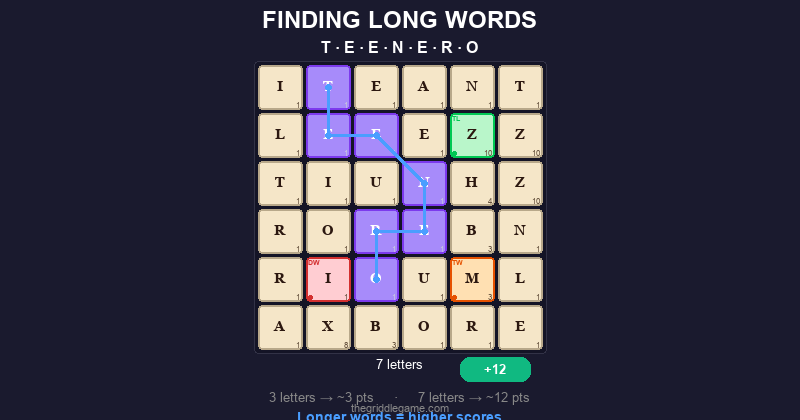
There's a particular thrill in Griddle that only comes from spotting a long word — tracing a winding path through six, seven, or even eight adjacent tiles and watching the points stack up. Long words are rare, impressive, and they earn you badges. But finding them consistently isn't about having a bigger vocabulary; it's about training your eyes to read the board differently.
This guide covers the techniques experienced players use to spot long words that most people miss entirely.
Why Long Words Matter
Beyond bragging rights, long words offer concrete advantages:
- More tiles = more points. A six-letter word using all 1-point tiles still scores 6, while most long words include at least one higher-value letter. The base score is naturally higher.
- Badge milestones. Griddle awards badges for finding words of five, six, seven, and eight letters. The seven- and eight-letter badges are some of the hardest to earn.
- Multiplier potential. A longer path through the grid has a better chance of crossing a bonus square. A seven-letter word through Triple Word is a massive score.
- Shuffle value. Every valid submission triggers a shuffle. One long word is as good as one short word for refreshing the board, but it scores much more.
Technique 1: Scan for Prefixes
Instead of reading tiles individually, look for common word beginnings clustered together on the board:
- RE- — RETURN, RETAIN, REMOVE, RESTORE
- UN- — UNTIE, UNITE, UNDER, UNROBE
- OUT- — OUTER, OUTLINE, OUTRUN
- OVER- — OVERTURN, OVERCOME
- PRE- — PRESENT, PRETEND, PREVIEW
- IN- — INTERNAL, INERT, INTER
When you spot a prefix, shift your attention to the tiles adjacent to the last letter of that prefix. What can you build from there? Even if the first word you envision doesn't work (broken adjacency or not in the dictionary), the prefix often leads to alternative completions you hadn't considered.
Technique 2: Scan for Suffixes
The reverse approach works just as well. Identify common endings and then work backward:
- -ING — If you see I, N, G clustered together, mentally prepend consonant-vowel combinations. RUNNING? TURNING? HUNTING?
- -TION — T, I, O, N in adjacency can anchor long words like PORTION, RATION, LOTION.
- -ER / -EST — These turn adjectives into comparatives and superlatives: LONGER, LOUDER, TALLEST.
- -ED — Past tenses extend any verb by two letters: TURNED, HUNTED, BURNED.
- -LY — Adverbs: LONELY, HOURLY, MERELY.
Technique 3: Follow the Vowels
English words alternate between consonants and vowels in roughly predictable patterns. When you're hunting for long words, trace paths that weave through vowel-rich areas of the board. A region with three or four vowels adjacent to useful consonants is prime territory for a five-to-seven-letter word.
Conversely, avoid spending time in consonant-heavy corners unless you spot a specific pattern like STR-, -GHT, or SCR- that you can build around.
Technique 4: Think in Word Families
When you find a four-letter word, immediately ask: can I extend it?
- Found TURN? Look for TURNS, TURNED, TURNER, RETURN, TURNING.
- Found HEAT? Check for HEATER, HEATED, REHEAT.
- Found RENT? Try RENTER, RENTAL, RENTED.
- Found LINE? Explore LINER, LINED, OUTLINE, LINEAR.
This cascading approach is efficient because you've already found and verified the core path. You're just checking whether adjacent tiles can extend it in either direction. Even if the extension doesn't work on this board layout, you've spent only a second or two checking.
Technique 5: Use Diagonal Adjacency
Newer players tend to trace words horizontally and vertically, forgetting that diagonal adjacency is equally valid. On a 6×6 grid, each interior tile has eight neighbors (four cardinal, four diagonal). Diagonal paths let you reach tiles that seem far apart visually but are actually adjacent.
Long words almost always require at least one diagonal step. A purely horizontal or vertical word on a 6×6 grid can be at most six letters — and that requires using an entire row or column, which almost never spells a valid word. Diagonal connections are what make seven- and eight-letter words possible by zigzagging across the board.
Technique 6: Read the Board After Every Shuffle
After submitting a word, the board shuffles and every letter changes position. This means long-word opportunities that didn't exist three seconds ago now might. Treat every post-shuffle board as a fresh puzzle with fresh possibilities.
Experienced players develop a quick post-shuffle scan routine:
- Check the bonus squares (which letters landed on multipliers?)
- Scan for obvious prefixes and suffixes
- Look for vowel clusters
- If nothing long jumps out within 5 seconds, grab a short word and shuffle again
How Long Is Realistic?
On a typical Griddle board with 36 tiles drawn from the standard letter pool:
- 3–4 letter words: Dozens exist on most boards. These are your bread and butter.
- 5 letter words: Several per board, reliably findable with practice.
- 6 letter words: Usually 1–3 per board layout (counting all shuffle arrangements). Finding one in a game is a solid achievement.
- 7 letter words: Rare. Not every board layout supports one, and finding it requires both the right tiles and a valid adjacent path. This earns a badge.
- 8+ letter words: Extremely rare. The board needs a fortunate letter distribution and a long connected path. Finding one is a standout achievement.
Practice Makes Pattern Recognition
Finding long words is a skill that improves with repetition. The more boards you see, the faster your brain will recognize common letter clusters and word patterns. Bonus games are perfect for practice — you can play unlimited rounds without affecting your stats, giving you low-pressure repetition to train your eye.
Start today: play today's Griddle, and when the board loads, spend your first ten seconds looking for just one word of five letters or more. Over time, you'll be spotting six- and seven-letter words without even trying.