Griddle Strategy: How to Maximize Your Score in 3 Minutes
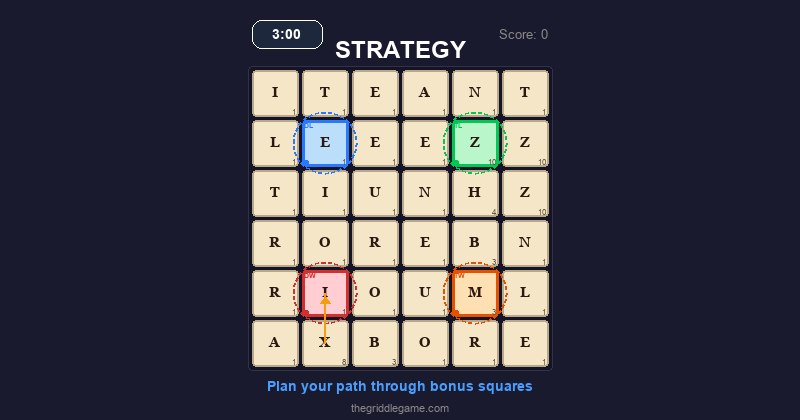
Three minutes sounds like plenty of time — until the timer starts. In Griddle, the difference between a middling score and a great one often isn't vocabulary size but how efficiently you use the clock. This guide covers the strategic principles that separate casual players from consistent high scorers.
The First Ten Seconds: Scan, Don't Search
When the board appears after the countdown, resist the urge to immediately start building a word. Instead, spend five to ten seconds scanning three things:
- What letters are on the bonus squares? The four multiplier positions are fixed. Check which letters landed on Double Letter, Triple Letter, Double Word, and Triple Word. A high-value letter (J, X, Q, Z, K) on a multiplier square should be your first target.
- Are there any obvious long words? Scan for familiar prefixes (UN-, RE-, OUT-) and suffixes (-ING, -TION, -ED) that might form a long word through adjacent tiles.
- Where are the vowels? Vowel clusters create more word possibilities. Identify where A, E, I, O, U are concentrated — that's where your words will form most easily.
This quick survey gives you a mental map of the board. Instead of randomly tracing paths, you're targeting high-value opportunities from the start.
Strategy 1: Prioritize Bonus Squares
The four bonus squares are the most important feature on every board. A three-letter word that passes through Triple Word can outscore a six-letter word on plain tiles. After every shuffle, the first thing you should do is check which letters now sit on multiplier squares.
Think of bonus squares as magnets for your attention. Even if you can only form a short word through one, it's almost always worth submitting — you score the multiplied points and trigger a shuffle that might open up something even better.
Strategy 2: Speed Over Perfection
New players often spend 15–20 seconds chasing one long word. That's a significant chunk of your three minutes. In most cases, you'll score more by finding three quick words in that same span.
The math is simple: three four-letter words averaging 6 points each give you 18 points in 20 seconds. One six-letter word might score 10–12 points — if you find it. And if you don't, you've just burned 20 seconds for nothing.
The exception is when you spot a long word through a multiplier. That's worth pursuing because the payout justifies the time investment. But on plain tiles, fast and short beats slow and long.
Strategy 3: Use the Shuffle Strategically
Every valid word submission triggers an automatic shuffle, and you can also shuffle manually at any time. Many players underuse the manual shuffle — they treat it as a last resort when they should treat it as a tool.
If you've scanned the board for five seconds and nothing jumps out, shuffle. You're not losing anything — the same 36 letters stay in play, just in new positions. A fresh layout often reveals words that were invisible in the previous arrangement.
When to Shuffle
- You've been staring for more than 5 seconds without seeing a word
- The bonus squares have low-value letters (all 1-point tiles) and you want a better draw
- You've found the obvious words and the remaining adjacencies feel exhausted
When Not to Shuffle
- You see a high-value word forming but haven't traced the path yet
- A premium letter (J, X, Q, Z) is sitting on Triple Letter or Triple Word — milk it first
Strategy 4: Work the Vowel Clusters
English words almost always contain vowels, so areas where vowels cluster together are natural word-building territory. When you identify a pocket of 2–3 vowels near some useful consonants, focus there. You'll find more words per scan than in consonant-heavy regions of the board.
Conversely, don't waste time trying to build words through a consonant desert (a patch of four or five consonants with no nearby vowels). Unless you spot something like "HYMN" or "RHYTHM," move on.
Strategy 5: Think in Prefixes and Suffixes
Instead of reading the board letter-by-letter, train yourself to recognize word parts. If you see T-H adjacent, you've got "TH" — now look for what follows: THE, THEN, THEIR, THIN, THAW. If you see I-N-G in a cluster, work backward to find what comes before them.
Common patterns to scan for:
- Prefixes: UN-, RE-, IN-, OUT-, PRE-, DIS-, OVER-
- Suffixes: -ED, -ER, -ING, -TION, -LY, -EST, -NESS
- Common pairs: TH, SH, CH, QU, WH, PH
This approach is faster than brute-force scanning because you're testing structural patterns rather than trying every possible path.
Strategy 6: Don't Forget the Three-Letter Words
It's tempting to chase long words for the prestige (and the badges), but three-letter words are the backbone of a high score. They're fast to find, fast to submit, and they trigger shuffles that change the board. A skilled player can submit a three-letter word every 3–4 seconds during a good streak.
Keep a mental list of common three-letter words: ARE, ATE, EAR, EAT, ERA, IRE, NET, OAR, ORE, RAN, RUN, TEN, THE, TIN — these appear on most boards and can be found almost instantly once you train your eye.
Strategy 7: Manage the Clock
With three minutes on the clock, you roughly want:
- First minute: High-value plays. Grab the multiplier words, find any long words, submit the easy wins.
- Second minute: Volume. Shift to rapid-fire shorter words. Shuffle freely. Keep the submissions flowing.
- Final minute: Hustle. The timer turns red at 60 seconds. Don't start any ambitious long-word hunts — stick with whatever you can grab in 3–5 seconds.
When the timer shows under 15 seconds, you should already have a word selected and ready to submit. Don't get caught mid-selection when time expires.
Putting It All Together
The best Griddle players combine these strategies fluidly. They scan for bonus squares first, grab high-value opportunities quickly, shuffle without hesitation when the board looks dry, and maintain a steady pace of submissions throughout the game. They don't agonize over missing a word — every shuffle is a new chance.
The good news is that these skills improve with practice. Play the daily game consistently, and you'll notice your pattern recognition getting faster, your shuffle timing improving, and your scores climbing. Check your progress on the stats screen and work toward the score badges as milestones.
Ready to test these strategies? Play today's Griddle and see how your score compares.