5 Common Griddle Mistakes and How to Avoid Them
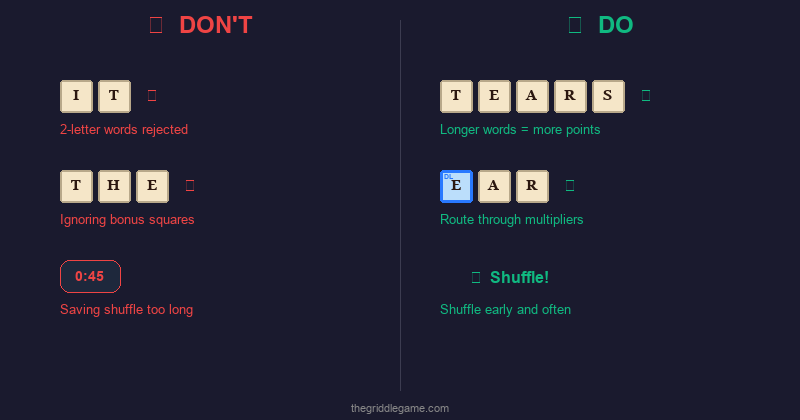
Everyone makes mistakes when they start playing Griddle. The game looks simple — find words on a grid — but the scoring system, time pressure, and board mechanics create subtle traps that cost points. Here are the five most common mistakes new players make and exactly what to do instead.
Mistake #1: Ignoring the Bonus Squares
This is the single biggest point leak for new players. The bonus squares are where the real scoring happens. Two players with identical vocabularies can have dramatically different scores based purely on how well they exploit multipliers. Make checking the four bonus positions your first move after every shuffle — before scanning the rest of the board.
Mistake #2: Spending Too Long on One Word
Three minutes is 180 seconds. If you spend 30 seconds on one word, that's 17% of your game gone on a single attempt. In that same time, an efficient player could submit three or four short words for 15–20 points. Unless the long word passes through a multiplier (making the payout worth the time), speed beats perfectionism.
The exception is a clearly visible long word through a bonus square. If you can see "RETURN" passing through Triple Word, that's worth the extra seconds. But chasing a vague possibility isn't.
Mistake #3: Never Using the Shuffle Button
The shuffle button is one of the most underused tools in Griddle. Word submissions trigger automatic shuffles, but between submissions you should be shuffling manually whenever the board feels dry. Think of it this way: would you rather stare at a difficult arrangement for 15 seconds, or shuffle and potentially spot three easy words in that same time?
Strategic shuffling also gives you fresh chances at bonus square combinations. A shuffle might drop a Z on Triple Letter or a K on Double Word — opportunities that didn't exist moments ago.
Mistake #4: Only Looking for Long Words
The math tells the story clearly. In three minutes, a player who submits 20 three-letter words averaging 4 points each scores 80 points. A player who submits five long words averaging 10 points scores 50 points and probably spent several unproductive seconds between each one.
The best players combine both approaches: they grab obvious long words and multiplier words when they see them, but they fill the gaps with a rapid stream of short words. Long words are the bonus, not the strategy. For more on this balance, see our strategy guide.
Mistake #5: Forgetting About Diagonal Adjacency
Diagonal adjacency is what makes Griddle's word-finding deep. Without diagonals, you're limited to straight-line paths of at most six tiles (one row or column). With diagonals, you can trace winding paths that cover much of the board, enabling words of seven or eight letters.
A helpful exercise: before your next game, pick any tile on the board and mentally identify all its neighbors. Do this for a few tiles across the board. It only takes a few sessions before diagonal scanning becomes automatic. For more on using diagonals to find longer words, see our post on finding long words.
Bonus Mistake: Not Playing Daily
This isn't a gameplay mistake, but it's worth mentioning: many players don't realize that only the daily game counts toward stats, badges, and streaks. If you play only bonus rounds, you'll never earn a badge or build a streak. Make the daily game your first play of the day, then enjoy as many bonus rounds as you like afterward.
Consistency is also how you improve. The more daily games you play, the better your pattern recognition becomes. What feels slow today will feel automatic in a week. For tips on building a daily habit, see How to Build and Maintain a Streak.
Quick Reference
- #1 — Ignoring bonus squares: Check them first after every shuffle.
- #2 — Dwelling on one word: 5-second rule — move on or shuffle.
- #3 — Not shuffling: Shuffle is free and unlimited. Use it.
- #4 — Only chasing long words: Short words are your scoring backbone.
- #5 — Forgetting diagonals: Every tile has up to 8 neighbors, not 4.
Fix even one of these habits and you'll see an immediate improvement in your scores. Play today's Griddle with these tips in mind and see the difference.