Griddle Tile Values: Which Letters Are Worth the Most?
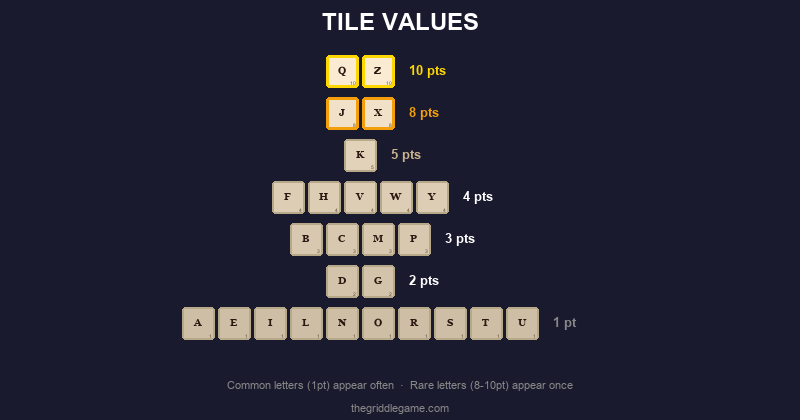
Every tile in Griddle has a point value printed in its corner, but not all players think much about it. Understanding which letters are worth the most — and how often they appear on the board — gives you a strategic edge. This post breaks down Griddle's letter values, the logic behind the distribution, and how to use that knowledge to score higher.
The Complete Value Table
Griddle assigns point values based on letter rarity in English. The more common a letter is, the less it's worth. Here's every letter ranked by value:
| Points | Letters | Count | Category |
|---|---|---|---|
| 1 | A, E, I, O, U, L, N, S, T, R | 10 letters | Common |
| 2 | D, G | 2 letters | Common |
| 3 | B, C, M, P | 4 letters | Moderate |
| 4 | F, H, V, W, Y | 5 letters | Uncommon |
| 5 | K | 1 letter | Uncommon |
| 8 | J, X | 2 letters | Rare |
| 10 | Q, Z | 2 letters | Very rare |
Understanding the Distribution
The value tiers aren't arbitrary — they reflect how frequently each letter appears in English text. The relationship is inverse: the more a letter shows up in everyday language, the more tiles of it exist in Griddle's tile pool, and the less each one is worth.
The 1-Point Majority
Ten letters — nearly 40% of the alphabet — are worth just 1 point. These are the workhorses of English: vowels (A, E, I, O, U) and the most common consonants (L, N, S, T, R). They appear frequently on every Griddle board because the tile pool is weighted toward them. On a typical 36-tile board, you'll see 20–25 of these common letters.
Because they're everywhere, 1-point letters are easy to build words with. A word like "STORE" (all 1-point tiles) scores only 5 points, but you can find these words quickly and reliably. They're the bread and butter of a fast-paced game.
The 2–5 Point Middle Tier
The middle tier spans from D and G (2 points each) through B, C, M, P (3 points), F, H, V, W, Y (4 points), and K (5 points). These letters are moderately common — you'll usually see several per board but not as many as the 1-point tiles.
Middle-tier letters add meaningful value to words without being hard to find. A word like "WHIP" (W=4, H=4, I=1, P=3) scores 12 on plain tiles — solid for a four-letter word. The key is recognizing these letters and incorporating them into your words instead of defaulting to all-1-point paths.
The Premium Letters: J, X, Q, Z
The four premium letters are where excitement meets strategy. J and X are worth 8 points each, while Q and Z command a full 10 points. They're rare — the tile pool has very few of them, so many boards won't have any, and a board with two is unusual.
When a premium letter appears on your board, it should immediately become a priority target. Including a J in any word adds 8 points to the base score. On a multiplier? The value skyrockets:
Z (10) on Double Letter = 20 points from one tile
J (8) on Triple Letter = 24 points from one tile
Q (10) on Triple Letter = 30 points from one tile
Any of these feeding into a word through Triple Word multiplies the entire total by 3.
Value Per Letter: What the Numbers Mean in Practice
Here's another way to think about tile values — what adding a specific letter to a word is actually worth compared to a common alternative:
- Swapping an E (1 pt) for an H (4 pts) in a word adds 3 points. Through Double Word, that's +6. Through Triple Word, +9.
- Using a K (5 pts) instead of an N (1 pt) adds 4 points to the base — and potentially 8 or 12 through word multipliers.
- Finding a word that includes Z (10 pts) instead of a word of the same length with all 1-point tiles adds 9 points to the base. Through TW, that's +27 points.
This marginal-value thinking is how experienced players choose between two similar words. If you can spell both "TIN" and "KIN," choose KIN — it scores 3 more points at the same effort.
Tile Frequency on the Board
Griddle draws 36 tiles for each board from a weighted pool. Common letters have more tiles in the pool and are drawn more often. Here's a rough sense of what you'll typically see:
- E, A, I, O: Expect 2–4 of each per board. Multiple copies of these vowels are normal.
- T, N, R, S, L: Usually 2–3 each. These consonants are word-building staples.
- U: Typically 1–2. Less common than other vowels.
- D, G, B, C, M, P: Usually 1–2 each.
- F, H, V, W, Y, K: Often 0–1 each. Some boards won't have any H or W.
- J, X, Q, Z: Usually 0. When one appears, it's notable.
This distribution means most boards are dominated by 1-point tiles with a scattering of mid-value consonants. The rare appearance of a J, X, Q, or Z is what creates breakout scoring opportunities.
Strategic Takeaways
- Spot premium letters immediately. When the board loads or shuffles, quickly scan for J, X, Q, Z. If one exists, build a word through it — especially if it's near a bonus square.
- Choose higher-value paths. When two words are equally easy to find, pick the one with higher-value tiles. "CHIEF" beats "RINSE" in both base score and fun.
- Don't ignore common tiles. Volume from 1-point words adds up. Twenty words at 4 points each still scores 80 — a respectable game.
- Watch for mid-tier value adds. An H, W, or Y in a word adds 4 points — barely less than K at 5. These letters are easy to overlook but cumulatively valuable.
- Multipliers amplify value gaps. The difference between a 1-point and a 10-point letter is 9 points on plain tiles but 27 points through Triple Word. High-value tiles on multiplier squares are the highest-leverage plays in the game.
Play today's Griddle and notice which letters appear on the board — you'll start seeing value patterns you never noticed before.