How Griddle Scoring Works: A Complete Guide
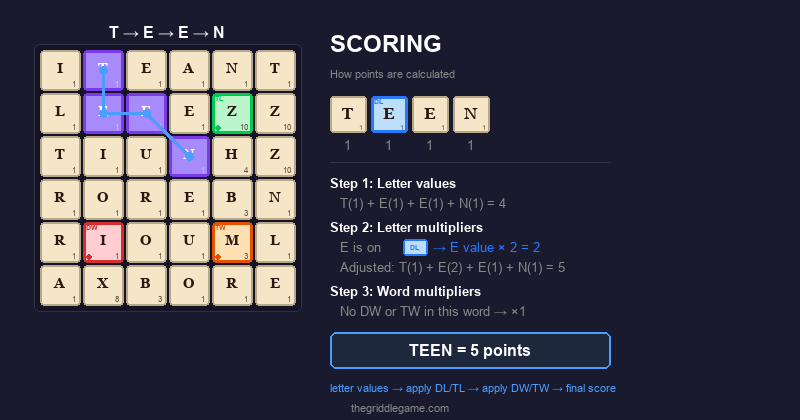
If you've played a few rounds of Griddle and wondered why some three-letter words score higher than others — or how a five-letter word can sometimes beat a seven-letter one — the answer comes down to the scoring system. Griddle borrows ideas from both Boggle and Scrabble, combining adjacency-based word finding with a tile-value and multiplier system that rewards strategic thinking over sheer word count.
This guide breaks down every component of scoring: individual letter values, the four bonus square multipliers, the order in which multipliers are applied, and concrete examples so you know exactly how your score is calculated.
Letter Values
Every tile on the 6×6 board has a point value printed in its bottom-right corner. Values are assigned by letter rarity — the more common a letter is in English, the fewer points it's worth. Here's the complete table:
| Points | Letters | Notes |
|---|---|---|
| 1 | A, E, I, O, U, L, N, S, T, R | The most common English letters. You'll see many of these on every board. |
| 2 | D, G | Moderately common consonants. |
| 3 | B, C, M, P | Less frequent but still appear regularly. |
| 4 | F, H, V, W, Y | Uncommon letters that add up quickly. |
| 5 | K | Rare enough to stand alone in this tier. |
| 8 | J, X | High-value tiles. Building a word through these is usually worth the effort. |
| 10 | Q, Z | The rarest and most valuable. A Q or Z on a multiplier square can be game-changing. |
Base Word Score
A word's base score is simply the sum of the point values of every tile in the word. For example, "CAT" uses C (3) + A (1) + T (1) = 5 points. "QUIZ," if you could find one on the board, would be Q (10) + U (1) + I (1) + Z (10) = 22 points before any multipliers.
Bonus Squares
Four fixed positions on the board carry multipliers. These squares are the key to high scores — they can double or triple a letter's value or your entire word's score. You can identify them by the colored badge in the tile's corner.
Letter Multipliers
Letter multipliers affect only the tile sitting on that specific square:
- Double Letter (DL) — at row 2, column 2 — doubles the value of the letter on this square. An E (normally 1 point) becomes 2; a K (normally 5) becomes 10.
- Triple Letter (TL) — at row 2, column 5 — triples the letter value. A J on Triple Letter is worth 24 points by itself.
Word Multipliers
Word multipliers apply to the entire word after letter multipliers have been resolved:
- Double Word (DW) — at row 5, column 2 — doubles the total word score.
- Triple Word (TW) — at row 5, column 5 — triples the total word score. This is the single most powerful square on the board.
For a deeper look at bonus square positions and strategy, see Understanding Bonus Squares and Tile Placement.
Multiplier Order of Operations
When a word passes through multiple bonus squares, the multipliers are always applied in the same order:
- Letter multipliers first. Any DL or TL bonuses are applied to their respective tiles to calculate adjusted tile values.
- Sum all tile values. Add up every tile in the word (with adjusted values where applicable) to get the base word total.
- Word multipliers last. Any DW or TW bonuses multiply the entire base total.
This order matters because it means word multipliers amplify letter multipliers. A letter that's been tripled feeds into a word that's then doubled — you get the best of both.
Worked Examples
Example 1: Simple Word, No Bonuses
Base score: 4
Multipliers: None
Final score: 4 points
Example 2: Word with a Double Letter
Calculation: H (4 × 2 = 8) + I (1) + N (1) + T (1)
Base score: 11
Multipliers: DL already applied
Final score: 11 points
Example 3: Word with Letter and Word Multipliers
Step 1 — letter multiplier: H (4 × 2 = 8)
Step 2 — sum tiles: 8 + E (1) + L (1) + P (3) = 13
Step 3 — word multiplier: 13 × 2 = 26
Final score: 26 points
Example 4: The Dream Scenario
Step 1 — letter multiplier: J (8 × 3 = 24)
Step 2 — sum tiles: 24 + A (1) + X (8) = 33
Step 3 — word multiplier: 33 × 3 = 99
Final score: 99 points — from a three-letter word!
This is why bonus squares matter so much. A well-placed short word through two multipliers can outscore a long word that misses them entirely.
Scoring Strategy in Practice
Understanding the scoring system changes how you approach each board. Here are a few principles that follow directly from the math:
- High-value letters on letter multipliers are gold. Placing a J, X, Q, or Z on the Triple Letter square is one of the most efficient ways to boost your score. Always check what letter is sitting on TL and TW.
- Word multipliers amplify everything. Even a modest 6-point word becomes 18 through Triple Word. The DW and TW squares should be your first scan on every new board layout.
- Short words through multipliers beat long words on plain tiles. A 3-letter word scoring 99 points (see Example 4 above) is hard to match with any word on unmarked squares. Don't overlook short opportunities near bonus squares.
- Volume still matters. You only have three minutes. After grabbing the obvious high-multiplier words, shift to finding as many quick 3–4 letter words as you can. Each one adds to your total and triggers a shuffle that might land new letters on bonus squares.
- Shuffling resets the bonus square opportunity. After a shuffle, different letters land on the four multiplier positions. Check them again — that fresh Z on Triple Letter might be your biggest score of the game.
What Doesn't Affect Scoring
A few things that players sometimes assume matter but don't:
- Word length has no inherent bonus. There's no extra multiplier for finding a 6-letter word versus a 3-letter word. The only advantage of length is more tiles contributing to the sum.
- Speed doesn't affect points per word. Finding a word in 2 seconds scores the same as finding it in 20. Speed matters only because the clock is running — more time means more words.
- Submission order doesn't matter. Your first word of the game scores identically to your last. There's no combo system or chain bonus.
Now that you understand the scoring math, put it into practice: play today's Griddle and see how high you can push your score. For broader strategy advice beyond scoring, check out our strategy guide.