The Griddle Board: Understanding Bonus Squares and Tile Placement
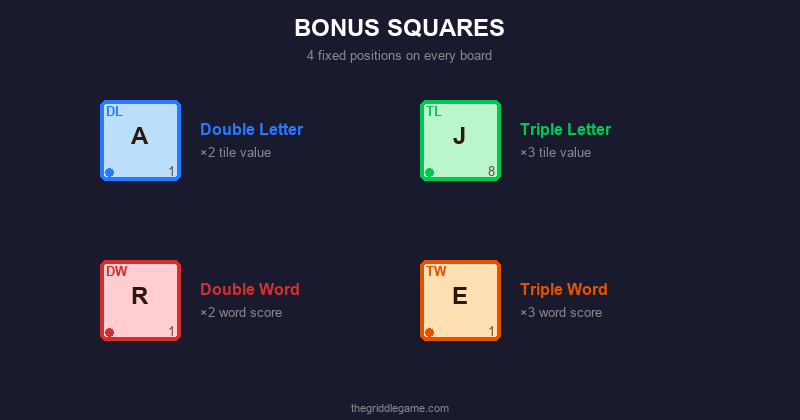
If you've been playing Griddle for a while, you've noticed the colored badges on certain tiles — DL, TL, DW, TW. These mark the four bonus squares, and they're the single biggest factor separating average scores from exceptional ones. Understanding where they are, what they do, and how to build words through them is the foundation of Griddle strategy.
The Four Bonus Squares
Griddle's 6×6 board has exactly four bonus squares at fixed positions. While the letter tiles shuffle after every word submission, these special positions never move. Here's what each one does:
| Square | Grid Position | Effect |
|---|---|---|
| Double Letter (DL) | Row 2, Column 2 | Doubles the point value of the letter sitting on this square |
| Triple Letter (TL) | Row 2, Column 5 | Triples the point value of the letter on this square |
| Double Word (DW) | Row 5, Column 2 | Doubles the entire word's score after letter bonuses |
| Triple Word (TW) | Row 5, Column 5 | Triples the entire word's score after letter bonuses |
Where They Sit on the Board
Here's a diagram of the 6×6 grid with the bonus square positions marked. Each cell shows either a dot (plain square) or its bonus abbreviation:
Row1 · · · · · ·
Row2 · DL · · TL ·
Row3 · · · · · ·
Row4 · · · · · ·
Row5 · DW · · TW ·
Row6 · · · · · ·
Notice the symmetry: the letter multipliers (DL, TL) are in row 2, and the word multipliers (DW, TW) are in row 5. The "double" variants are in column 2, the "triple" variants in column 5. This diagonal symmetry means the most powerful square (TW) is diagonally opposite the least powerful bonus (DL).
Letter Multipliers: DL and TL
Letter multipliers affect only the single tile occupying that square. When a letter tile lands on DL after a shuffle, its point value is doubled for any word that includes it. On TL, it's tripled.
The impact depends entirely on which letter happens to be on the square:
- An E (1 pt) on DL becomes 2 — a marginal gain of 1 point.
- A K (5 pts) on DL becomes 10 — a solid 5-point boost.
- A Z (10 pts) on TL becomes 30 — a game-changing 20-point bonus on a single letter.
- A J (8 pts) on TL becomes 24 — almost as impactful.
This is why checking which letters land on DL and TL after every shuffle is so important. A common letter on a multiplier is barely worth noticing; a rare letter is worth building your entire next word around.
Word Multipliers: DW and TW
Word multipliers apply after all letter-level calculations are complete. They multiply the entire word total — including any letter bonuses that were already applied.
This makes word multipliers disproportionately powerful:
- A 6-point word through DW scores 12 instead of 6.
- A 6-point word through TW scores 18 instead of 6.
- A 15-point word (with a letter bonus) through TW scores 45.
The key insight is that word multipliers amplify letter multipliers. If a word passes through both TL and TW, the tripled letter value feeds into the tripled word total. The multipliers compound rather than simply adding together.
Multiplier Stacking: The Order of Operations
When a word passes through multiple bonus squares, the calculation always follows the same steps:
- Apply letter multipliers (DL, TL) to their individual tiles
- Sum all tile values to get the base word total
- Apply word multipliers (DW, TW) to the entire total
Word passes through both TL (with X = 8 pts) and TW.
Step 1: X on TL → 8 × 3 = 24
Step 2: Remaining letters sum to 4 → word base = 24 + 4 = 28
Step 3: TW → 28 × 3 = 84 points
Without multipliers this same word would score 12.
For the complete scoring breakdown with more worked examples, see How Griddle Scoring Works.
Strategic Implications
Always Check the Bonus Squares After a Shuffle
This is the single most important habit to build. After every word submission (which triggers an auto-shuffle), glance at the four bonus positions before scanning the rest of the board. The letter that just landed on TW should dictate your next word search.
Build Words Through Multiple Bonuses
Because the bonus squares are at fixed positions, it's sometimes possible to trace a word that passes through two of them. The DL (row 2, col 2) and TL (row 2, col 5) are in the same row but three columns apart, so a word can occasionally connect them via intermediate tiles. Similarly, DW and TW share row 5. Spotting these dual-bonus paths is a high-level skill that dramatically boosts scores.
Short Words Through TW Are Almost Always Worth It
Even a three-letter word with common tiles (say, THE = 1+4+1 = 6) scores 18 through Triple Word. That's a strong return for a word that takes two seconds to find and submit. Don't overlook easy short words near TW just because they feel unimpressive.
Shuffling Is Your Friend
If the current letters on the bonus squares are all low-value (four 1-point tiles), a manual shuffle costs nothing and might drop a K, J, X, or Z onto TL or TW. The more shuffles you trigger (via submissions or manually), the more chances you get for a premium letter to land on a multiplier.
Bonus Squares in Daily vs. Bonus Games
In the standard daily game, the four bonus squares always start in their default positions with their default types. In bonus games with the "Dynamic Bonus Squares" beta feature enabled, the bonus types can shuffle among the four fixed positions after each board shuffle. This means DW might move to where TL used to be, adding another layer of strategic variety. The positions remain the same — only what type of bonus each position carries can change.
Whether you're playing the daily game or a bonus round, the fundamentals stay the same: check the bonus squares first, build words through them, and let the multipliers do the heavy lifting.
Ready to put this into practice? Play today's Griddle and pay close attention to those four squares.