What Dictionary Does Griddle Use?
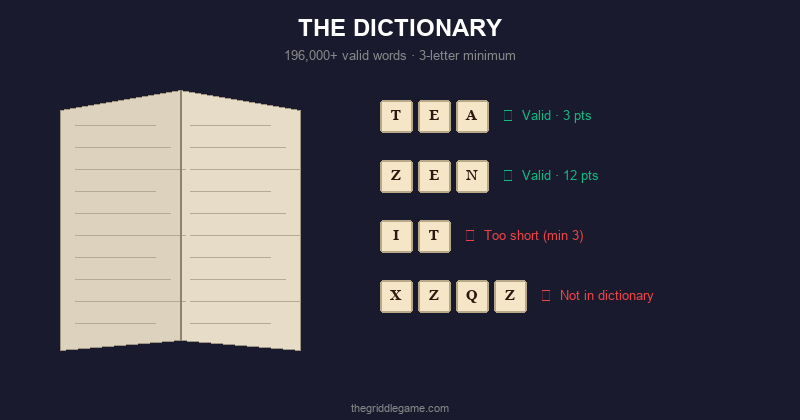
"Why wasn't my word accepted?" It's one of the most common questions Griddle players ask, and the answer almost always comes down to the dictionary. Griddle uses a custom word list derived from established competitive word-game dictionaries, containing approximately 196,000 valid entries. This post explains what that means in practice — what kinds of words are in, what's out, and why you'll occasionally be surprised in both directions.
A Custom Word-Game Dictionary
Griddle's dictionary is based on the word lists used in competitive word games — the same kind of curated lists that power tournament Scrabble and similar games. These lists are designed to include legitimate English words while excluding proper nouns, abbreviations, and other entries that don't belong in a word-finding game.
The key difference from a standard English dictionary (like Merriam-Webster or Oxford) is scope. A tournament word list includes many obscure but valid words that a regular dictionary might omit or mark as archaic. Conversely, some common informal words or recent slang may not be included because they haven't been added to the competitive word-game canon.
The Three-Letter Minimum
Griddle requires words to be at least three letters long. While some word games accept two-letter words (and competitive Scrabble players memorize a specific list of valid two-letter entries), Griddle's minimum keeps the gameplay focused on more meaningful word-finding. Two-letter words like "QI," "XI," or "ZA" — staples of competitive Scrabble — won't work in Griddle.
This design choice is intentional. On a 6×6 grid, two-letter words would be trivially easy to find (every pair of adjacent tiles could potentially be one), and they would dilute the challenge. Three letters is the sweet spot: accessible enough that you'll always find some, but long enough that you need to read the board.
Words You Might Not Expect to Be Valid
Because the dictionary comes from competitive word-game sources, it includes many words that might surprise casual players:
- Archaic words: Terms like "WERT" (past tense of "were" in old English), "HATH," and "DOTH" are valid.
- Uncommon but real words: "TARN" (mountain lake), "BOLE" (tree trunk), "NAVE" (church interior), "PLIE" (ballet move), and "RUNE" are all accepted.
- Scientific and technical terms: Words from botany, zoology, and chemistry that have entered the English lexicon are often valid. "ARENE," "OXID," and "ENOL" are examples.
- Informal but established words: "GROUT," "THUD," "SNAG," and other everyday words with solid dictionary credentials are included.
- Unusual short words: Three-letter entries like "AWE," "OAT," "EEL," "IRE," and "ARC" are valid and appear on boards frequently.
Words You Might Expect to Be Valid — But Aren't
The flip side of a curated word list is that some words you use every day might not be in it. Common categories of rejected words include:
- Proper nouns: Names of people, places, brands, and organizations are never valid. "PARIS," "GOOGLE," and "JAMES" will be rejected.
- Abbreviations and acronyms: "LOL," "USB," "NASA," and similar entries aren't accepted, even if they're widely used in everyday language.
- Very recent slang: Words that have entered common usage recently but haven't been added to formal word-game dictionaries may be missing. Slang evolves faster than word lists update.
- Hyphenated words: Entries like "SELF-MADE" or "WELL-KNOWN" aren't valid because Griddle only recognizes single continuous words.
- Foreign words not adopted into English: While many borrowed words are valid (CAFÉ becomes CAFE, etc.), words that are still considered foreign aren't included.
Common Frustrations and Why They Happen
"I know this is a real word!"
You're probably right — it is a real word. But competitive word-game dictionaries are conservative about inclusions. A word needs to appear in specific reference dictionaries to make the list. Being "a word people use" isn't quite enough; it needs formal dictionary backing from established lexicographic sources.
"But this word worked yesterday!"
If a word was accepted before, it should always be accepted. The dictionary doesn't change between games. If you're seeing this, it's more likely that a similar-looking word was valid (maybe you found "LEAN" yesterday and tried "LEANS" today, but the path wasn't valid for the plural form on today's board). Remember, the issue might be path adjacency rather than the dictionary itself.
"Weird words are accepted but common ones aren't"
This is the nature of competitive word lists. They were compiled for tournament play, where players memorize unusual entries as a strategic advantage. A word like "AALII" (a Hawaiian shrub) is valid in tournament play and therefore in Griddle, while some informal terms haven't made it into the official list. This can feel inconsistent, but it's consistent within the framework of the source dictionaries.
How the Dictionary Loads
Griddle downloads the full dictionary (about 1.9 MB) when you first visit the site. It's cached by your browser, so subsequent visits load much faster. All word validation happens locally in your browser — no server call is needed to check if a word is valid. This means the game works even with a spotty internet connection once the initial load is complete.
You might notice a brief loading indicator when you first visit Griddle — that's the dictionary downloading. Once it's loaded, word lookups are essentially instant because they use an in-memory set data structure optimized for fast existence checks.
Tips for Working With the Dictionary
- Always try. There's no penalty for submitting a word that isn't in the dictionary. Just tap Submit and move on — the game will tell you immediately.
- Learn from rejections. When a word is rejected, note it mentally. Over many games, you'll develop an intuition for what's likely to be valid.
- Explore uncommon words. Some of the most satisfying Griddle moments come from successfully playing a word you weren't sure about. Try unusual combinations — you might be surprised.
- Don't let rejections slow you down. The clock is ticking. If a word is rejected, move on immediately. Dwelling on it costs you time that could be spent finding other words.
- Remember: path matters too. Before assuming a word isn't in the dictionary, make sure your selected tiles actually form a valid adjacent path. A broken adjacency chain is a common reason for rejection that isn't about the word itself.
Ready to test your vocabulary? Play today's Griddle and see which words you discover — you might find a few surprises in the dictionary along the way.