Why Word Games Are Good for Your Brain
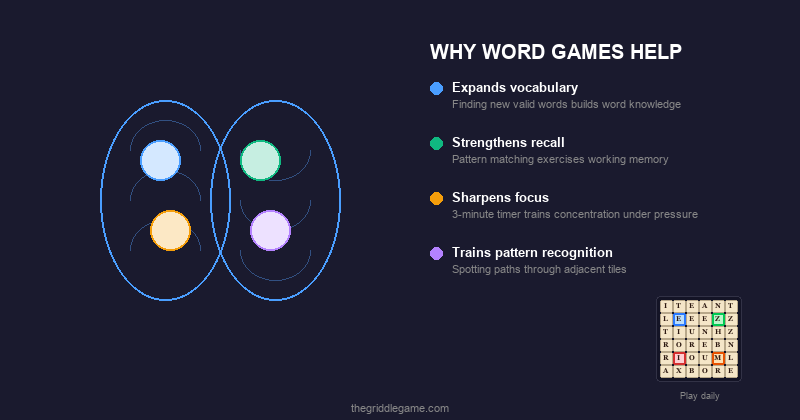
You probably play Griddle because it's fun. But there's a growing body of research suggesting that word puzzles do more than entertain — they exercise cognitive skills that matter in everyday life. This post looks at what scientists have found about the mental benefits of word games, how those benefits map to specific Griddle mechanics, and why a daily three-minute puzzle might be one of the best things you can do for your brain.
The Research: What Science Says
Cognitive scientists have been studying puzzle-solving for decades. While no single game is a magic bullet for brain health, the research consistently points to several benefits from regular engagement with word puzzles:
Vocabulary and Verbal Fluency
Studies published in journals like The Journals of Gerontology have found that people who regularly engage with word puzzles maintain stronger verbal fluency as they age. Verbal fluency — the ability to retrieve words quickly and accurately — is a fundamental cognitive skill that supports communication, reading comprehension, and writing.
Every Griddle game is an exercise in rapid word retrieval. You're scanning a grid, recognizing letter patterns, and pulling matching words from memory — all under time pressure. Over weeks and months of daily play, this repeated practice strengthens the neural pathways involved in word access.
Processing Speed
Timed puzzles in particular have been linked to improvements in processing speed — how quickly your brain can take in information, make sense of it, and respond. Research from the University of Exeter and King's College London found that adults who regularly solved word puzzles performed better on tasks measuring attention, reasoning, and information processing speed.
Griddle's three-minute timer is the key here. Unlike untimed word games where you can contemplate at leisure, Griddle forces rapid decision-making. Each second you spend deliberating is a second not finding another word. This gentle but persistent time pressure trains your brain to process visual information and make word-recognition judgments faster.
Pattern Recognition
Pattern recognition — the ability to identify meaningful structures in complex visual input — is one of the most trainable cognitive skills. It's also central to Griddle gameplay. Spotting "TH" and immediately looking for what follows, recognizing "-ING" clusters, and scanning for prefixes like "RE-" or "UN-" are all pattern recognition tasks.
Research in cognitive psychology suggests that pattern recognition improves with domain-specific practice. Chess players get better at recognizing board positions; musicians get better at recognizing note patterns; and word-game players get better at recognizing letter patterns. The improvement is measurable and persistent.
Working Memory
Working memory is your brain's ability to hold and manipulate information in the short term. When you're tracing a path through Griddle's grid, you're simultaneously tracking which tiles you've selected, what word you're building, whether the path is valid, and what the adjacent options are. That's a substantial working memory load — especially for longer words.
Regular exercise of working memory has been associated with improvements in focus, reading comprehension, and mathematical reasoning. While the transfer effects are debated in the literature, the direct benefits of exercising working memory through word puzzles are well-established.
How Griddle Specifically Exercises Your Brain
Not all word games are created equal from a cognitive perspective. Griddle's specific mechanics engage several cognitive systems simultaneously:
- Visual-spatial processing: Scanning a 2D grid, identifying adjacency relationships, and tracing paths through space. This is the same spatial reasoning used in map reading and navigation.
- Lexical access: Rapidly retrieving words from your mental dictionary based on available letters. This is verbal fluency in its purest form.
- Strategic decision-making: Choosing between a safe short word and a risky long word, deciding when to shuffle, weighing bonus square opportunities. These are executive function tasks — planning, prioritizing, and adapting.
- Time management: Allocating three minutes across competing priorities. Do you spend time hunting for a long word or submit three short ones? This is a real-world skill in miniature.
- Impulse control: Resisting the urge to keep searching for a word that isn't materializing and shuffling instead. Knowing when to cut your losses is a form of cognitive flexibility.
The Daily Habit Advantage
Perhaps the most important finding from cognitive research is that consistency matters more than intensity. A short daily session is more beneficial than a long weekly one. This is why Griddle's design — one three-minute daily puzzle — is so well suited for cognitive maintenance.
You're not being asked to commit an hour. You're not facing a grueling mental workout. You're doing a brief, enjoyable puzzle that exercises multiple cognitive systems, and then you go about your day. The streak system provides gentle motivation to keep the habit going, and the badge system provides long-term milestones that make progress visible.
Benefits Across Age Groups
Young Adults (18–35)
For younger players, word games primarily build vocabulary and sharpen processing speed. The timed aspect is especially valuable — rapid word retrieval under pressure is a skill that transfers to standardized testing, professional communication, and writing.
Middle-Aged Adults (35–60)
This age group benefits from the cognitive maintenance aspect. Research suggests that regular mental stimulation helps preserve verbal fluency and processing speed during the decades when these abilities naturally begin to slow. A daily word puzzle is a low-effort way to keep these systems active.
Older Adults (60+)
The research is most compelling here. Multiple studies have found that older adults who regularly engage with word puzzles show cognitive performance equivalent to people ten years younger on measures of memory and thinking speed. While word puzzles don't prevent cognitive decline, they appear to build cognitive reserve — a buffer that can delay the onset of noticeable symptoms.
What Word Games Don't Do
It's important to be honest about limitations. Word games like Griddle are not:
- A cure or prevention for dementia. No puzzle game has been shown to prevent Alzheimer's disease or other forms of dementia. The research shows correlation between puzzle engagement and cognitive function, but establishing direct causation is much harder.
- A replacement for physical exercise. Cardiovascular exercise remains the most well-supported intervention for brain health. Ideally, do both — play Griddle after your morning walk.
- A substitute for social connection. Social engagement is another strong predictor of cognitive health. Sharing your Griddle scores with friends combines puzzle-solving with social connection — a win on both fronts.
The Bottom Line
Playing word games like Griddle is genuinely good for your brain — not as a miracle cure, but as one component of an active mental life. The research supports benefits in vocabulary maintenance, processing speed, pattern recognition, and working memory. The daily format aligns with what we know about consistency and habit formation. And the three-minute commitment is low enough that virtually anyone can fit it into their day.
If you're looking for a reason beyond fun to play your daily puzzle, now you have several. Play today's Griddle and give your brain its three-minute workout.