Griddle vs. Wordle vs. Boggle: How Word Puzzles Compare
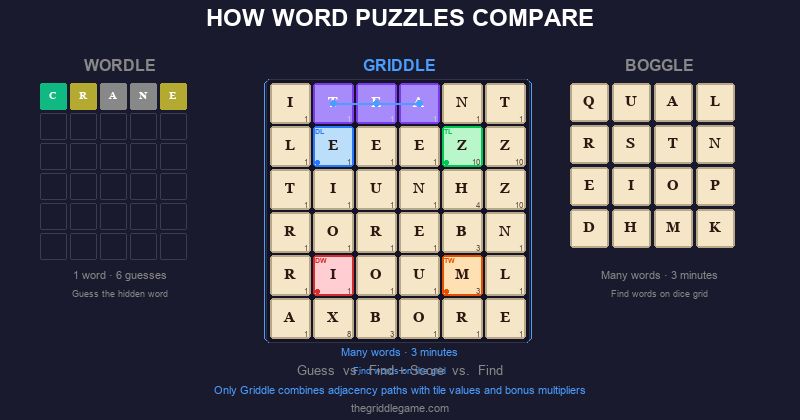
If you enjoy word games, you've probably played at least one of these three: Wordle, the viral daily guessing game; Boggle, the classic dice-based word finder; and Griddle, the daily grid puzzle that combines elements of both. While all three involve finding English words, they're fundamentally different games that test different skills. This post breaks down exactly how they compare.
Quick Comparison
| Feature | Griddle | Wordle | Boggle |
|---|---|---|---|
| Objective | Find as many words as possible | Guess one hidden word | Find as many words as possible |
| Grid size | 6×6 (36 tiles) | 5 letters (6 guesses) | 4×4 or 5×5 (16–25 dice) |
| Time limit | 3 minutes | None | 3 minutes |
| Scoring | Points per word (tile values + multipliers) | Win/lose (guess count) | Points by word length |
| Daily puzzle | Yes — same board for everyone | Yes — same word for everyone | No (physical game) |
| Multiplayer | Compare scores (same daily board) | Compare guess counts | Head-to-head (in person) |
| Platform | Web browser (free) | Web browser (free, NYT) | Physical board game |
| Skills tested | Pattern recognition, speed, strategy | Deduction, vocabulary | Pattern recognition, speed |
Wordle: The Deduction Game
Wordle, created by Josh Wardle and now hosted by The New York Times, is a daily word guessing game. You have six attempts to guess a five-letter word. After each guess, the game tells you which letters are correct (green), present but misplaced (yellow), or absent (gray). Success is binary: you either find the word or you don't.
What Wordle Does Well
- Elegant simplicity. The rules fit in one sentence: guess the word in six tries. Anyone can understand and start playing immediately.
- Social sharing. The colored-square grid became a cultural moment. Sharing your Wordle result without spoiling the answer is genuinely clever design.
- No time pressure. You can take as long as you want on each guess. It's a thinking game, not a speed game.
How Griddle Differs
Where Wordle is about narrowing down one word through logic, Griddle is about finding many words through visual pattern recognition. Wordle tests deductive reasoning; Griddle tests speed, vocabulary breadth, and spatial awareness. You can be excellent at one and mediocre at the other — they exercise different cognitive muscles.
Wordle also has no scoring gradient. You either solve it in 1–6 guesses or you don't. In Griddle, there's always a score to improve, a higher word count to chase, or a longer word to find. The feedback loop is continuous rather than binary.
Boggle: The Original Grid Game
Boggle, published by Hasbro, is the physical board game that pioneered the "find words on a grid" concept. Players shake 16 or 25 lettered dice into a tray, start a three-minute sand timer, and write down every word they can find by tracing adjacent dice. Points are awarded by word length, with longer words worth exponentially more.
What Boggle Does Well
- Physical, social experience. Sitting around a table shaking dice and comparing lists is genuinely fun. The in-person element adds energy.
- Pure word-finding. No multipliers, no special squares — just find words. The simplicity keeps the focus on vocabulary and speed.
- Competitive multiplayer. Boggle's scoring system (you only get points for words no one else found) encourages looking for unusual words, adding a strategic layer.
How Griddle Differs
Griddle inherits Boggle's core mechanic — adjacency-based word finding on a grid — but adds several dimensions:
- Tile values. In Boggle, all letters are equal. In Griddle, each tile has a point value, so a word with rare letters (J, X, Q, Z) scores more than one with common letters. This adds a layer of strategic choice that Boggle doesn't have.
- Bonus squares. Griddle's four multiplier positions (DL, TL, DW, TW) create scoring opportunities that don't exist in Boggle. A short word through Triple Word can outscore a long word on plain tiles — something impossible in Boggle's length-only scoring.
- Auto-shuffle. In Boggle, the board is static for the full three minutes. In Griddle, the board shuffles after every submission, giving you fresh layouts and new word possibilities throughout the game.
- Digital daily format. Boggle requires a physical set and other players. Griddle is available instantly in any browser, with a shared daily puzzle that creates a global comparison without needing to be in the same room.
- Larger grid. Griddle's 6×6 grid (36 tiles) is larger than standard Boggle (4×4 = 16), which means more letters, more word possibilities, and more complex adjacency paths.
What Griddle Takes From Each
Griddle sits in a unique space between Wordle and Boggle:
- From Wordle: The daily puzzle model (one puzzle per day, same for everyone, shareable results), the web-first no-account design, and the addictive streak mechanic.
- From Boggle: The grid-based word-finding gameplay, adjacency rules, the three-minute time limit, and the satisfaction of spotting words others might miss.
- From Scrabble: Per-tile point values and board multipliers that add strategic scoring depth beyond just finding words.
The result is a game that feels familiar to fans of any of these games but plays differently from all of them. The time pressure of Boggle, the daily ritual of Wordle, and the strategic scoring of Scrabble combine into something that rewards both quick thinking and calculated play.
Which Game Is Right for You?
- You like deduction puzzles: Wordle. If your favorite part of word games is the logical narrowing-down process, Wordle's six-guess structure is deeply satisfying.
- You like in-person game nights: Boggle. Nothing replaces the energy of competing face-to-face with friends and comparing word lists.
- You like speed + strategy: Griddle. If you want the thrill of timed word-finding combined with strategic scoring decisions, Griddle gives you both.
- You like all of them: Play all three! They test different skills and scratch different itches. Many Griddle players also play Wordle daily — the two complement each other nicely.
Ready to see how Griddle plays? Try today's puzzle — it takes the same three minutes you'd spend on a Boggle round, with scoring depth that Wordle fans will appreciate.